
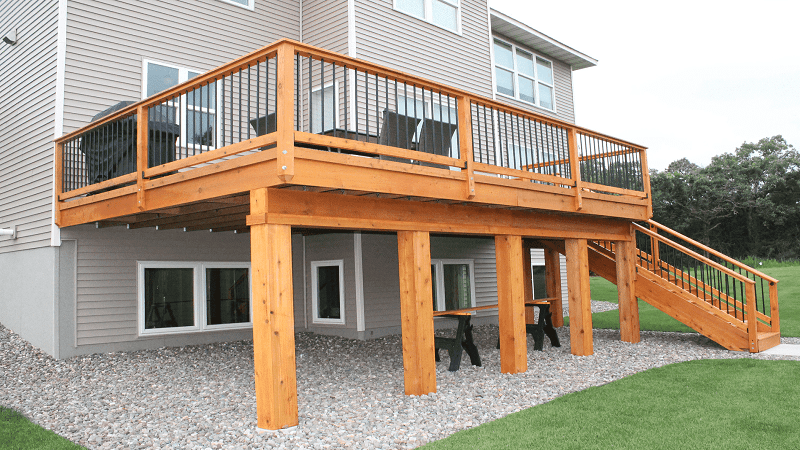
A new deck should fit how you live, what your property can accommodate, and the upkeep you are willing to handle. Before choosing colors or railings, work through the layout, approval requirements, structural design, and complete project budget. These new deck construction considerations help you develop a practical plan before committing to materials or construction.
What should you decide before designing your deck?
Determine what the deck is going to be used for, where it connects to the house, and what activities require their own space. An area designated for reading requires a different plan from one intended for dining outdoors. Begin with the basics rather than mimicking the measurements in a photo.
Make notes of the measurements of your furniture, taking into account that people need room to draw up their chairs. Draw paths from the house to seating, stairs, and garden areas. Try making your measurements and drawing on the ground itself so that you can test it.
Take this brief checklist of things to consider during planning:
- Primary function: Determine if the primary function of the deck is dining, relaxing, entertaining, or something else.
- Movement: Separate pathways from doorways and areas of furniture.
- Access: Think about who is going to use the stairs and if it requires expert consideration.
- Privacy: Make notes of the neighboring windows and the view that needs to be maintained.
Check the property before refining the plan
Inquire with the building and planning departments in your area about which permits, drawings, setbacks, and inspections apply to your site. Also, check for any association guidelines that may affect your planned area. Avoid assuming that an Internet-found deck plan complies with the regulations. Consider any Internet plans only as guides and confirm the specifics.
Look at your site after rain and observe where puddles form. Point out slopes, downspouts, utility equipment, and places that require ongoing access to your builder. Find out how your deck plan will take advantage of such features instead of working around them as construction challenges.
Create a simple site report with notes, pictures, and questions. Use it in early discussions with your contractor, so that each one can be working from the same information. It’s also helpful when comparing plans.
If you’d like to be more organized in your preparation for those discussions, use this permits and inspections checklist before asking for bids.
Build the budget around the complete project
Get an itemized quotation instead of making comparisons on the prices of the decking boards only. Get contractors to quote different costs for each of the site preparations, foundations, framing, decking, guards, stairs, labor, permits, and cleanup costs. If lighting or electrical installation is one of the items you want, make sure to get its cost as well.
Consider different options with different considerations. Get different prices for built-in seats, borders, or extra stairs, and evaluate which of these makes sense for the budget based on the improved usability of these options. Leave some cash aside until the state of the site is assessed. If you are deciding what to schedule first, these year-end home improvement tips for busy homeowners can help you sequence the work around your other projects.
Compare the different proposals based on the same written scope. Make sure to clarify products, responsibilities for approvals, inspection stages, payments, and the change approval process.
Which decking material fits your maintenance expectations?
Select deck materials based on how the individual products compare in terms of their maintenance needs, installation needs, and looks. It is important to note that wood and composite have unique maintenance considerations. While composite is advertised as easy to maintain compared to wood, there is always maintenance associated with any material.
For those considering stone deck vs composite as their options, this can be seen as an opportunity to choose an excellent material combination according to how they plan to utilize their deck. There will be situations where stone-like surfaces work well in terms of temperature tolerance, rigidity, or even appearance requirements. Conversely, the composite material is a good choice in terms of having consistent boards, an easy installation process, and a regular maintenance procedure. This is why the comparison process is not about finding the “best” product; but rather, the best fit in terms of their framing, drainage system, and the climate of their area. It is advisable that they begin with the installation guidelines of the product and confirm the necessary requirements with their architect or builder first.
Obtain samples and have them checked against their siding during the daytime. They should also ask for information regarding cleaning, availability of replacements, and the limitations of the warranties.
Give structural details priority over decorative features
Have your contractor walk through the basics for you before you make any decisions on decorating the deck. In order to verify your ideas and the information given to you, compare your ideas with the American Wood Council’s DCA 6 deck construction guide to see where professional engineering might be necessary for your project.
Be sure to disclose any plans for a hot tub or other heavy loads right from the beginning. Many of the requirements for standard decks do not cover large concentrated loads, so do not assume that a basic layout confirms anything. Ask if engineering is required for your project.
For designing deck ideas, a deck planner tool will allow you to play around with furniture placement, location of stairs, and traffic patterns. Organize your options, and then consult your builder and department as to what documents and design ideas are required.
If you want to get a structural review of your deck prior to consulting a contractor, read this deck framing and ledger attachment guide.
Plan maintenance before construction begins
The best deck maintenance advice relates directly to the materials used on the deck. Get your maintenance instructions before purchasing, as well as information about which products, equipment, and procedures are allowed. Particular care is needed for rules regarding pressure washing, snow and ice removal, and restrictions related to mats, grills, and planters.
Prior to transfer, create a maintenance file that includes:
- Product information: Decking types, color and fastener specifications, and purchase receipts.
- Maintenance instructions: Allowed cleaning procedures and warranties.
- Project information: Approved drawings, inspection records, and contractor contacts.
Get the builder to explain which areas will be available for inspections. Determine who you will talk to about problems with movement, damage to the decking, or loose connections.
Choose a deck you can comfortably live with
Only finalize the project once the design, permissions, structural method, cost, and maintenance requirements all match up. Make practicality more important than aspects you might never use. This will provide you with a more solid basis for your material choices and contractor comparison.