
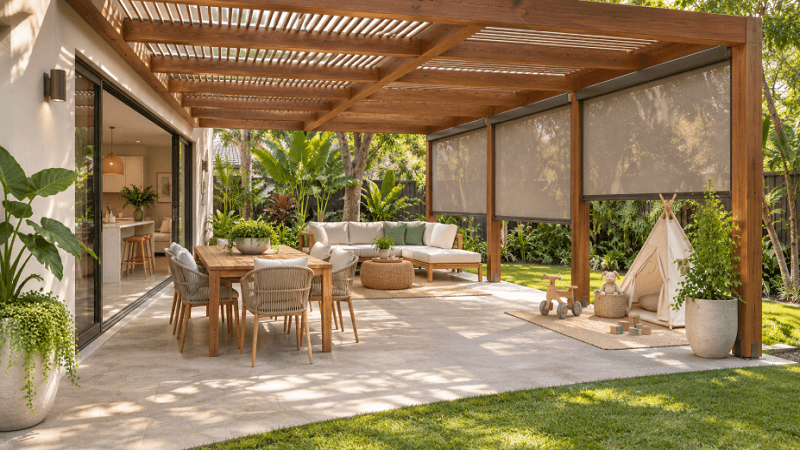
Many patios may be very appealing early in the day but almost unusable by mid-to-late afternoon, when the sun beats down on every surface and insects turn up in time for the evening meal.
There are many things to consider when creating a suitable area for a family. Ideally, you want as much shade as possible over every area people use, as few openings as possible for insects to get in, and enough space and facilities for the children.
All of this can be achieved with a few simple additions to an existing patio.
In this article:
- Track sun and shade through the day
- Provide the right mix of fixed and movable shading
- Minimize insect access
- Make the additions as safe as possible
- Use lighting to extend usable hours
- Select low-maintenance options
- Summary
Track sun and shade through the day
It’s worthwhile observing and recording the extent and positions of sun and shade around the existing patio area throughout a typical day, from early morning to late afternoon.
Much of it may be pleasantly shaded at some times of day, but fully exposed at others. In particular, areas shaded by an overhead structure at certain times may receive strong low-angled sun later in the afternoon, which may be directly in the eyes of people, often children, sitting at table height.
According to the Cancer Council, shade can reduce UV exposure by up to 75%. That is significant, but people should still take other measures to protect their skin and eyes, and wear a hat, when necessary.
It helps to identify:
- the main spots where people sit, particularly the children;
- the times of day these spots get direct sun;
- the approximate direction of the strongest, most uncomfortable sun;
- how exposed they are to the usual prevailing breezes.
From this, you should be able to work out what extra shading you need: overhead only, vertical only, or a combination of the two.
Provide the right mix of fixed and movable shading
Fixed overhead structures, such as a pergola or an eaves extension (a wider roof overhang), can help block overhead sun, depending on their design. Various types of movable shading can then cut out lower-angled direct sun reaching other areas during parts of the morning and afternoon.
Some outdoor blinds can shade a seating area when needed, then retract at other times to open up the view and let in any available breeze. They come in a wide range of styles, materials, and mounting methods, so it’s important to choose the ones best suited to your patio.
Depending on the style, some will block the view through them more effectively than others, and some will let more air through. It’s worth asking about each product’s screening level and UV protection rating, and ideally seeing samples.
Take particular care to provide enough vertical shading, especially on the west side, to stop strong, low sun from passing under an overhead structure and making seats uncomfortable.
Minimize insect access
Well-chosen shading may also keep out some insects, but it generally won’t close off every entry point.
To minimize the number of insects where the family eats, close off all reasonable openings as far as practicable, using appropriately sized mesh and screens on doors.
Where a patio is open on several sides, make sure screens fit snugly against the ground, the top edge, and any fixed structures such as posts. Even a small gap around a post can let plenty of insects in. A retractable screen may be a convenient option for any frequently used access points to and from surrounding areas.
It also helps to eliminate, as far as possible, places where insects can lay their eggs. Following NSW Health recommendations, remove all unnecessary containers that can hold water; empty and clean pot saucers and animal water bowls; clear gutters and drains; and securely screen rainwater-tank openings.
It makes sense to set up a routine, perhaps once a week, to:
- empty and turn over anything that collects water;
- wash and refill water containers;
- check that drains are clear;
- replace damaged screening.
People may also wish to apply suitable insect repellents to their skin, following the directions on the packaging. Whatever precautions you take, there will always be some chance of insects getting in.
Make the additions as safe as possible
Ideally, any improvements should also make the area safer for the children.
As with indoor venetian blinds (see the Australian Competition and Consumer Commission, or ACCC), it’s desirable to eliminate any danger from dangling cords as far as possible. Ask suppliers what options are available for the particular type of outdoor blind or screen you choose. At the very least, keep any hanging cords out of easy reach of small children.
Keep walkways clear around the area, for example to the kitchen, barbecue, and garden. Potted plants, storage containers, or other items in the way would be inconvenient and possibly dangerous.
Make sure all tables and seating are stable and that storage-box lids can’t easily trap fingers. Secure any freestanding structures properly, and make sure all electrical items are suitable for outdoor conditions.
There will usually be one area best suited to children’s play. It should have as much sun protection as possible and ideally be clearly visible from where the adults sit. It can be tempting to put it at the far edge of the available space to free up room elsewhere, but that’s probably unwise.
Use lighting to extend usable hours
Mosquitoes are often most active at dusk and into the evening, and you’ll need adequate lighting so that people, especially children, can move around safely.
Ideally, have reasonably good lighting where tasks are done, such as walkways and the cooking area, and softer lighting over general seating areas so bright light doesn’t shine directly into people’s eyes.
Where appropriate, a fan can help circulate any available breeze through an enclosed area, but don’t rely on it to keep insects out.
It’s also convenient if the area can be divided so the children have their own table away from where food is prepared.
If you use heaters, place them all well clear of hanging materials and other combustible items, as their manufacturers recommend.
Select low-maintenance options
Any improvements should be as convenient as possible, so they’re more likely to be fully used as intended rather than neglected. Choose materials that are easy to clean, both of dust and storm debris and of the inevitable grease and grime from everyday use.
It’s also useful to schedule a regular check ahead of the times you use the area most: clean around sliding mechanisms and drains, check that all screens are intact, and make sure moving parts work properly.
Good storage makes it much easier to tidy away loose items and keep the area looking neat.
Summary
With careful thought, many patios can be made more comfortable, with better shade and fewer insects. Once those are sorted, adding comfortable seating and other facilities is fairly straightforward. Hopefully, this will encourage the family to enjoy the area more often.