
Quick Answer
Shorter daylight hours widen the window when houses sit empty and unlit, so the home security Calgary households rely on needs review before the clocks change. Verify every entry-point contact, raise cameras above snow accumulation, reset exterior lighting to actual sunset rather than a fixed summer schedule, and confirm the panel reports through a cellular path that survives a power interruption. Household internet alone will not manage that.
Introduction
Sunset lands before five o’clock through December, which means most houses in the region stand dark and empty across the late-afternoon hours when someone is most likely to test a back door. The equipment installed in June was configured against a different pattern. Lighting timers set for 8:00 p.m. now fire three hours after full darkness, and cameras aimed at a summer sightline lose the lower third of their frame once snow banks against a foundation.
Seasonal review is the step most households skip, and it is where home security Calgary coverage quietly degrades between one winter and the next. Providers such as Supreme Security build around a sensor-based model in which each protected zone reports a breach on its own, so a single untested contact leaves a real gap. The correction takes an afternoon: test, reposition, re-time, and confirm how the signal leaves the building.
Why Shorter Days Change What Security Systems Calgary Homes Need
Calgary Police Service publishes monthly break-and-enter counts by community through its Community Crime Statistics dashboard, which lets any resident check the trend for their own neighbourhood. What is not in dispute is the exposure window. Between the September equinox and the winter solstice, this latitude loses roughly seven hours of daylight.
The Late-Afternoon Exposure Window
A house that read as occupied at 6:00 p.m. in July reads as empty at 4:30 p.m. in November. Nothing about the building changed. The signal it broadcasts did.
Schedules set against summer conditions now run hours behind actual sunset, and anyone judging occupancy from the street sees an unlit property during the busiest approach hours of the day.
Deterrence, Detection and Response as Separate Jobs
Households often treat protection as one purchase. Four distinct functions are involved, and winter degrades them unevenly.
- Deterrence: visible lighting, cleared sightlines, signage, and a property that looks tended rather than abandoned
- Detection: contacts on doors, windows and screens, plus motion coverage across the approach path
- Response: transmission to a monitoring centre and the dispatch that follows
- Verification: the seasonal check confirming the first three still work as configured
Deterrence weakens first, because snow, early darkness and an unshovelled driveway all say the same thing. The result is that detection and response carry more weight exactly when their hardware faces the hardest conditions.
What Winter Changes About Entry Points
Basement windows sit below the drift line. Garage service doors go unused for months and stop being checked. Screens removed in October leave a contact reporting on a frame that no longer holds anything. Each remains listed as protected on the panel.
Cold Weather Placement for Security Cameras Calgary Homeowners Install
Placement decisions made in summer fail quietly once the ground changes height. Snow accumulation raises the effective floor of a property, and a lens aimed at a walkway in August ends up framing a drift by January.
Sightlines That Disappear Under Accumulation
A unit mounted at 2.4 metres over a side gate loses its most useful ground detail once 40 centimetres of snow banks against the fence line. Faces move out of frame. Footwear and gait, the details that support identification, sit below the crop.
Raising the mount and steepening the down-angle costs nothing and holds through the season.
Infrared, Glare and Reflective Surfaces
Night vision struggles in ways product listings rarely mention. Fresh snow throws infrared illumination straight back into the lens, washing the near field to white while leaving anything beyond eight metres in shadow. Faults worth checking before the first heavy fall:
- Illuminators pointed at a light-coloured wall, fence or garage door within two metres
- Housings without a hood, collecting frost overnight and clearing only after midday
- Units behind glass, where interior reflection defeats the imager entirely
- Battery-powered models rated for indoor temperatures, losing runtime as the mercury drops
- Mounts on gutters and fascia that shift under ice load
The reality is that most of these are corrected with a screwdriver and twenty minutes.
How Video Fits With the Rest of the System
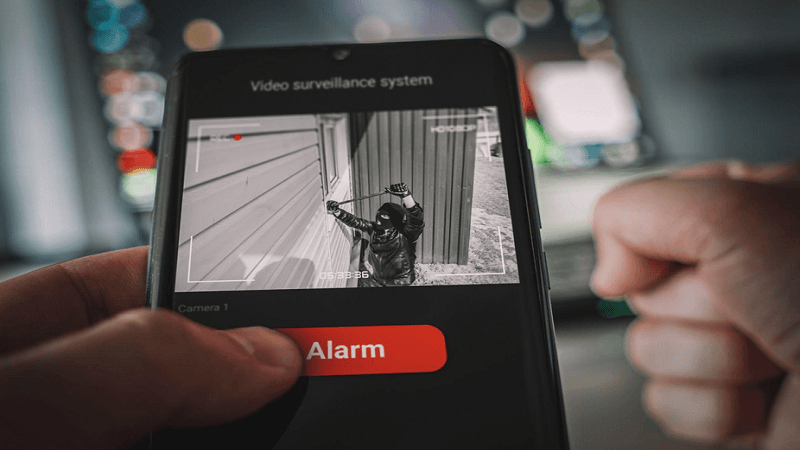
Footage answers what happened. It does not summon anyone. Detection still runs through door contacts and motion detectors, and the alarm systems Calgary providers install report each zone breach independently. Video confirms; sensors trigger. Neither function replaces the other, and a household that fits only one has covered half the job.
Winter Upkeep for Alarm Monitoring Calgary Households Depend On
Every seasonal checklist tells readers to test their detectors. Almost none address how the signal leaves the building, which is the failure point that matters most during a regional storm.
The Communication Path Nobody Checks
A panel reporting over household internet shares a fate with the router. Power drops, the router dies, and the panel has nothing to transmit through, even with its own battery holding. A cellular module bypasses that dependency, needing neither a landline nor broadband. The three configurations compare as follows:
| Configuration | Behaviour in a Power Cut | Ongoing Dependency |
| Internet only | Stops reporting once the router loses power | Broadband and household electricity |
| Cellular module | Keeps reporting on the panel battery | Carrier coverage at the property |
| Dual path with backup battery | Keeps reporting, with automatic failover | Either path remaining available |
Households in the region should know which row describes their own panel before the first outage, not during it.
Seasonal Verification Worth an Afternoon
Testing costs nothing beyond a call to the monitoring centre to place the account in test mode.
- Trip every door and window contact and confirm each registers as its own zone
- Replace backup batteries showing low-battery signals rather than waiting for failure
- Confirm the entry delay still suits the household routine, typically thirty seconds to three minutes
- Walk-test motion detectors after any furniture move
- Verify app notifications arrive on a phone that will be away from the property
Pro Tip: Move motion detectors mounted above a heater, furnace or forced-air register before the heating season starts. Rising warm air and shifting blinds cause most winter false activations, and both are fixed by relocating the device rather than lowering its sensitivity.
Reducing False Activations in Cold Months
Every false trip trains a household to disarm reflexively. That habit costs more than any municipal fee attached to it.
Dark Season Readiness for a Monitored Home
Winter preparation is a review of choices already made against conditions that no longer apply: a timer set in June, a camera aimed at bare ground, a panel that depends on a router, a contact on a screen taken down months ago. Each takes minutes to correct in October and costs a season of coverage if left alone. The home security Calgary households already own performs well when someone checks them before daylight goes.