
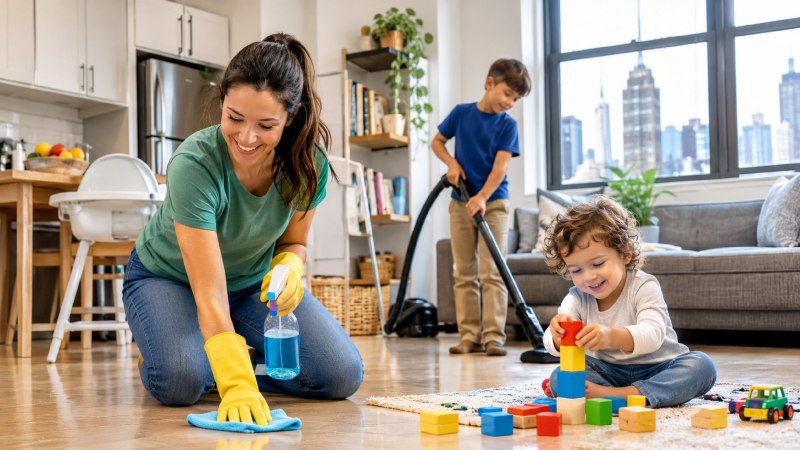
Parents in every borough ask the team at Green Hands Cleaning Services of New York City the same thing: “How do I keep a tiny apartment clean and safe with kids?” A crawling baby finds every crumb. A toddler finds every outlet. A school-age kid brings home every cold in the classroom.
Most parenting guides assume you have a house with a yard, a mudroom, and a garage. In New York, you might have a one-bedroom on the fourth floor of a walk-up. This guide is built for that life.
Families Are a Big Part of New York City
New York is often seen as a city for singles. The numbers say otherwise.
- About 1 in 5 New Yorkers is under 18, based on Census American Community Survey (ACS) data. That is more than 1.5 million children.
- Roughly 100,000 babies are born in NYC each year, according to the NYC Department of Health and Mental Hygiene (DOHMH).
- About 2 out of 3 NYC households rent, per ACS data. Many families can’t renovate, add storage, or install built-in safety features.
- More than 1 in 3 New Yorkers was born in another country, per ACS data. Many families raise kids with grandparents in the same apartment.
That last point matters. Three generations in a two-bedroom means more people, more dishes, more laundry, and more germs passing between the very young and the very old.
The NYC Window Guard Law Every Parent Should Know
This is the one rule most new parents in the city don’t know about.
Under the NYC Health Code, landlords of buildings with 3 or more apartments must install window guards in any unit where a child 10 years old or younger lives. They must also install them in hallway windows. The law has been in place since 1976. DOHMH credits it with a sharp drop in child deaths from window falls.
Here is what you need to do:
- Fill out the annual notice. Landlords send a form each January asking if a child 10 or under lives in the unit. Return it.
- Ask for guards in writing if you have a new baby, even mid-year. You don’t have to wait for the form.
- Know the exceptions. Windows that open onto a fire escape don’t get standard guards. Those need approved fire-escape-safe options so the exit stays usable.
- Call 311 if your landlord doesn’t install them.
Window guards also change how you clean. Dust and city soot collect on the bars and the sill behind them. Wipe them with a damp cloth once a month. Never remove a guard to clean the window.
What NYC Parents Keep Asking
These questions come up again and again in NYC parent forums and neighborhood groups.
“How do I keep street grime out when we use a stroller every day?”
City parents don’t drive from garage to garage. They push strollers through sidewalks, subway stations, and parks. The wheels pick up everything along the way. Then the stroller rolls straight into a small apartment.
- Keep a wet wipe pack or old towel by the door. Wipe the wheels before the stroller comes inside.
- Park the stroller in the same spot every time, on a washable mat.
- Go shoes-off at the door. Many NYC families already do this as a cultural habit. A shoe rack by the door makes it easy for guests too.
- Wash the stroller seat cover once a month, or right after a spill. Most covers come off and can be machine washed.
“My baby is crawling. How clean does the floor need to be?”
Babies put their hands in their mouths all day. In older NYC buildings, floor dust can hold things you don’t want them eating, including lead dust from old paint.
- Wet mop or damp wipe floors, don’t dry sweep. Dry sweeping stirs up fine dust.
- Use a vacuum with a HEPA filter. It traps fine particles instead of blowing them back out.
- Wipe windowsills and baseboards often. These are the most common spots for lead dust in pre-1960 buildings.
- Ask your pediatrician about lead testing. New York State requires lead tests for children at ages 1 and 2.
“Daycare germs keep making our whole family sick. Can cleaning help?”
Yes, but you need the right tool for the right germ.
- For most colds and flu, regular cleaning plus disinfecting high-touch spots helps. Think doorknobs, light switches, faucet handles, phones, and the TV remote.
- For norovirus, the stomach bug that sweeps through daycares in winter, alcohol wipes and many sprays don’t work well. The CDC advises a bleach solution on hard surfaces. Follow the label and the CDC’s mixing guide.
- For hand, foot, and mouth disease, common in summer and fall, wash toys that go in mouths with soap and water, then disinfect.
- Clean first, then disinfect. Disinfectant works poorly on surfaces covered in dirt or sticky food.
- Never mix bleach with ammonia or other cleaners. The fumes are toxic.
“Are bath toys really full of mold?”
Often, yes. In a 2018 study, Swiss researchers from Eawag and ETH Zurich cut open bath toys used in real homes. They found slimy layers of bacteria and fungi, called biofilm, inside most of them. The study was published in npj Biofilms and Microbiomes.
Squeeze toys with a small hole at the bottom suck in dirty bathwater and never fully dry. That is especially true in NYC bathrooms with no window and a weak fan.
- Seal the hole with a dab of hot glue so water can’t get in.
- Choose solid toys with no holes, or toys that come apart so you can clean inside.
- Dry toys in a mesh bag hung outside the tub after each bath.
- Toss any toy that squirts out black or brown flecks.
“Where do I store cleaning products when I have no high cabinets?”
Many NYC kitchens have only under-sink storage. That is the first place a toddler looks.
- Install child safety latches on every lower cabinet that holds cleaners.
- Move laundry pods up high or into a locked box. Poison centers in the U.S. get thousands of calls each year about young children and laundry detergent packets. The packets look like candy and burst in the mouth.
- Keep products in their original bottles. Never pour cleaner into a water bottle or cup.
- Save the Poison Help number: 1-800-222-1222. It is free, open 24 hours, and offers help in many languages.
“How often should I clean the high chair?”
After every meal, wipe the tray and seat. Once a week, take apart the straps and wash them. Food hides in the buckles and strap slots, where it grows mold and smells. Many straps can go in a laundry bag in the washer. Check the label first.
A Seasonal Calendar for NYC Families
Each season in New York brings its own messes and health worries for kids.
Fall (September to November):
- School starts, and so do the colds. Set up a “drop zone” by the door for backpacks, lunch boxes, and shoes.
- Wash lunch boxes every day. Old food in a warm bag grows bacteria fast.
- NYC heat season starts October 1. Dust radiators before they turn on, and add radiator covers if you have crawling babies. Steam radiators get hot enough to burn small hands.
Winter (December to February):
- Norovirus and flu peak. Disinfect high-touch spots more often.
- Steam heat dries the air. A clean humidifier helps, but empty and dry it daily. A dirty tank can spray mold into the room.
- Salt and slush from sidewalks track in on boots. Use a boot tray and a washable mat.
Spring (March to May):
- Tree pollen peaks in April and May. Wipe sills with a damp cloth and wash kids’ bedding weekly if they have allergies.
- Sort outgrown winter clothes. Many neighborhoods have kids’ clothing swaps and parent groups that pass items on.
Summer (June to August):
- Sprinklers, sandboxes, and beach days bring sand and sunscreen into the home. Rinse feet and toys before coming inside.
- Hand, foot, and mouth disease spreads in summer camps. Wash shared toys often.
- Many NYC apartments have no central air. Hot rooms make food spills sour faster, so wipe them up right away.
Small-Space Habits That Save Your Sanity
- Use one toy bin per room. At night, everything goes back in. Five minutes, done.
- Rotate toys. Keep half in a closet and swap every few weeks. Less out means less mess, and old toys feel new again.
- Store vertically. Over-the-door organizers hold diapers, wipes, and small toys.
- Make cleanup a game. Kids as young as 2 can put blocks in a bin. Turn on a song and race to finish before it ends.
When Parents Get Help
Parents in NYC are busy. Many work long hours and commute far. Outside help makes sense when:
- You just had a baby and are running on little sleep.
- Your whole family just got over a stomach bug.
- You are prepping a nursery in an older apartment and want dust cleared first.
- You are hosting a birthday party in a small space.
A cleaner who works with families knows where kid messes hide, from high chair buckles to the floor behind the crib. You can see how that works on the Green Hands cleaning service for new parents page.
The Bottom Line
Raising kids in a New York apartment takes a little extra planning. Return your window guard form every January. Wet wipe floors and sills instead of dry sweeping. Use bleach for norovirus, not just wipes. Seal or toss squeeze bath toys. Lock up laundry pods. Small habits keep a small home safer, cleaner, and easier to live in for the whole family.
About Green Hands Cleaning Services Corp
Green Hands Cleaning Services Corp is a residential cleaning company based in East Elmhurst, Queens. The team cleans homes across New York City, including Queens, Brooklyn, and Manhattan. Services include deep cleaning, apartment and house cleaning, disinfection services, home organization, move-in and move-out cleaning, and recurring maid service. The company works with renters, homeowners, new parents, busy professionals, and multigenerational families. Its cleaners know the challenges of raising a family in a city home, from steam radiators and windowless bathrooms to small kitchens and tight storage.
Green Hands Cleaning Services Corp
22-16 79th St, East Elmhurst, NY 11370, United States
greenhandscleaningservices.com
+1 212-812-9418