
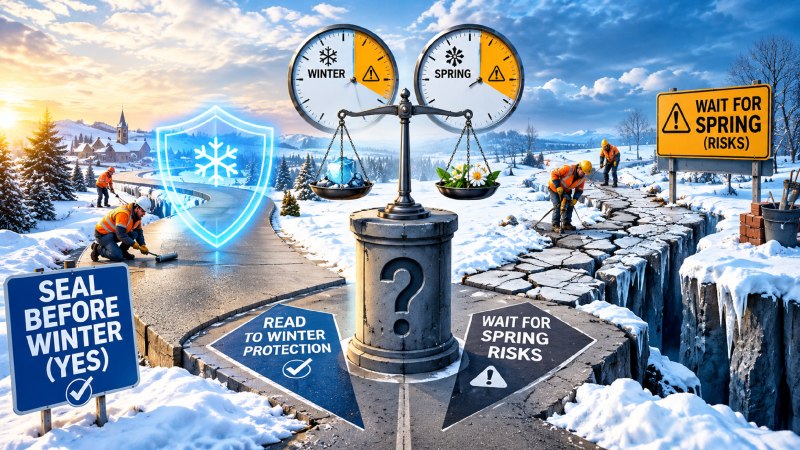
For Michigan homeowners, September is more than the beginning of fall. It is also a useful time to look around the property and consider what needs to be done before winter arrives. Driveways, patios, sidewalks, and other concrete surfaces that seem perfectly fine during the warmer months can face a very different environment once freezing temperatures, snow, ice, and deicing products become part of the daily routine.
One question that often comes up this time of year is whether concrete should be sealed before winter or whether it is better to wait until spring.
There is no single answer for every concrete surface. The right decision depends on the condition of the concrete, the type of sealer being considered, whether an old coating is already present, recent repairs, moisture conditions, and whether there is enough suitable weather left to complete the project properly.
Sealing concrete in the fall can make sense when the surface is in good condition and the project can be completed during an appropriate weather window. On the other hand, waiting until spring may be the better option when the concrete needs substantial repairs, has moisture problems, or cannot be prepared and sealed correctly before temperatures become too cold.
September provides homeowners with an opportunity to make that decision before winter limits their options.
Why September Is a Good Time to Inspect Concrete
Michigan’s weather can change quickly as fall progresses. A warm September afternoon can be followed by much cooler nights, and conditions become increasingly unpredictable as October and November approach. That makes early fall a practical time to inspect outdoor concrete and determine whether it needs attention.
The goal is not necessarily to seal everything immediately. Instead, homeowners should look at the condition of each concrete area and identify problems that could become more noticeable after months of winter exposure.
Start with the areas that experience the most traffic and weather exposure. A driveway may show tire wear, surface deterioration, stains, or small cracks. A patio might have discoloration, scaling, or areas where water tends to remain after rain. Walkways can develop cracks or uneven sections that become more difficult to manage when temperatures drop.
Look closely at the surface rather than judging it from a distance. Concrete that appears solid may still have small cracks, areas of surface wear, or signs that an older coating is beginning to fail.
September also gives homeowners time to make a plan. If sealing is appropriate, there may still be a suitable weather window. If repairs are needed first, there may be enough time to address them before winter, or the homeowner may decide that a more extensive spring project is more practical.
The important thing is to avoid waiting until the first hard freeze to start thinking about the condition of the concrete.
What Does Concrete Sealing Actually Do?
Concrete is strong and durable, but it is not completely unaffected by water and environmental exposure. Depending on the type of concrete and its surrounding conditions, moisture can enter the surface and contribute to various forms of deterioration.
A concrete sealer can provide a protective layer that reduces the penetration of water and helps protect the surface from certain environmental contaminants. Some sealers can also enhance the appearance of concrete by adding a particular finish or bringing out the existing color.
However, sealing is not a cure for every concrete problem.
A sealer will not turn badly cracked or structurally damaged concrete into a new surface. It also should not be treated as a substitute for proper drainage, crack repair, joint maintenance, or correcting underlying problems.
This distinction is important when deciding whether to seal before winter.
If the concrete is structurally sound and mainly needs additional protection, sealing may be worth considering. If the surface has significant damage, preparation and repair should take priority.
Examine the Concrete for Cracks Before Sealing
Cracks are one of the first things homeowners should look for during a September inspection.
Not every crack means the same thing. Small surface cracks can have different causes from large, widening, or uneven cracks. Some may be relatively minor, while others can indicate movement or a more significant issue beneath the surface.
Walk the entire area and look carefully at:
- Hairline cracks
- Wider cracks
- Cracks that appear to be expanding
- Areas where the concrete has separated
- Cracks around joints
- Cracks near steps or structures
- Areas where one section appears higher or lower than another
- Cracked sections that collect water
The pattern and location of a crack can provide useful information, but homeowners should avoid assuming that every crack can simply be filled and sealed.
If the concrete is moving or the underlying drainage is poor, applying sealer over the problem does not solve the cause.
Small cracks may sometimes be suitable for appropriate repair before sealing, depending on the concrete and the repair material being used. Larger or more complicated cracks may require professional evaluation.
The key point is simple: inspect first, repair where necessary, and seal only when the surface is ready.
Pay Attention to Surface Deterioration
Cracking is not the only sign that concrete needs attention.
Homeowners should also check for surface deterioration. This can include areas where the top layer appears rough, flaky, pitted, or unusually worn. Concrete exposed to repeated moisture and freezing conditions can experience surface stress, particularly when the material, installation, drainage, or exposure conditions are unfavorable.
Look for changes in texture across the surface.
Does one section look noticeably rougher than another? Are small pieces of the surface breaking away? Does the concrete appear chalky or powdery? Are there areas where the surface has lost its original appearance?
These observations can help determine whether the concrete is a good candidate for sealing before winter.
A sealer may be useful as part of a preventive maintenance approach when the concrete is otherwise sound. But if substantial surface deterioration is already present, the homeowner may need a different solution.
This is one reason September inspections are valuable. They give you time to distinguish between a maintenance project and a repair project.
Consider How Water Behaves on the Surface
Water is one of the most important things to consider when evaluating concrete before winter.
After rain, walk around the driveway, patio, or walkway and observe where water goes. Does it drain naturally? Does it remain in low spots? Does water run toward the foundation or collect near cracks?
Standing water can be a sign that the surface has drainage or grading issues.
Before sealing concrete, homeowners should understand where moisture is coming from and how it moves across the surface. Applying a protective coating without addressing a persistent moisture problem may produce disappointing results.
Moisture can also affect the sealing process itself. Many concrete sealing products require the surface to be adequately dry before application. The exact requirements depend on the product, so homeowners should always follow the manufacturer’s instructions.
A September project should therefore be planned around both the condition of the concrete and the weather.
Check for Previous Coatings
If the concrete has been sealed or coated before, that history matters.
An old coating may still be intact, partially worn, peeling, discolored, or incompatible with a new product. Applying a new sealer over an existing coating without determining whether the surfaces are compatible can create problems with adhesion and appearance.
Take a close look at the existing finish.
If some areas look glossy while others appear dull, there may be uneven wear. Peeling or flaking can indicate that the old coating is no longer performing as intended. In some situations, the existing material may need to be removed or properly prepared before a new product can be applied.
Homeowners should also try to determine what type of product was previously used if that information is available.
Knowing the history of the surface can make it easier to determine what preparation is necessary. If the previous coating is unknown, professional advice may be useful before applying another product.
A new layer should not simply be treated as a quick way to hide an old failing coating.
Surface Preparation Matters More Than Timing Alone
Homeowners sometimes focus heavily on whether September or spring is the better time to seal concrete. But timing is only one part of the equation.
Proper preparation is equally important.
A sealer needs a suitable surface to perform as intended. Dirt, grease, loose material, stains, old coatings, and other contaminants can interfere with the application process.
Depending on the condition of the concrete and the product being used, preparation may involve cleaning, removing loose material, treating stains, repairing cracks, and allowing the surface to dry adequately.
Livonia residential power washing company may be part of surface preparation for certain concrete sealing projects. It can help remove accumulated dirt and some surface contaminants, but it is not automatically the right solution for every concrete surface or every sealing product.
The cleaning method should match the condition of the concrete.
After cleaning, the surface may need sufficient time to dry before sealer is applied. This becomes particularly important in fall because cooler temperatures and changing humidity can slow drying.
A rushed preparation process can undermine an otherwise well-timed sealing project.
Is Fall Sealing Better Than Spring Sealing?
The answer depends on the individual property.
Fall sealing can be practical when the concrete is in good condition, the surface can be prepared properly, and the weather remains within the requirements of the selected product.
One potential advantage of addressing the concrete before winter is that the homeowner is not entering the cold season with a maintenance task that could have been handled earlier. If the surface is suitable for sealing, completing the project during an appropriate fall weather window can be part of a broader maintenance routine.
Spring has its own advantages.
By spring, homeowners can see what the winter actually did to the concrete. Any new cracks, surface deterioration, or areas affected by winter exposure are easier to identify. This can make spring a logical time for surfaces that need repairs or more extensive work.
However, spring weather can also be unpredictable. Rain, saturated soil, temperature changes, and other conditions can delay outdoor projects.
Waiting until spring is therefore not automatically better. Sealing in spring is not a replacement for proper preparation and suitable application conditions.
The better question is:
Is the concrete ready to be sealed now, and are the weather conditions suitable for doing it correctly?
That question provides a more useful basis for the decision.
Weather Windows Matter in Michigan
One of the biggest considerations for a fall concrete sealing project is the weather window.
Concrete sealer manufacturers typically specify application conditions, including acceptable temperatures and drying or curing requirements. Those requirements vary depending on the product.
Homeowners should not assume that a sunny day automatically means conditions are suitable.
Temperature matters. Moisture matters. Rain forecasts matter. Overnight temperatures matter.
A sealer may need a certain amount of time to dry or cure before the surface is exposed to rain, freezing temperatures, or heavy traffic. If temperatures are falling quickly after application, the process may not proceed as expected.
This is why September is often more useful for planning than waiting until late fall. Earlier in the season, homeowners may have more opportunities to identify a suitable stretch of weather.
Always follow the specific instructions for the sealer being used rather than relying on a general temperature rule.
If the forecast is uncertain or the project requires several preparation steps, professional scheduling can help reduce the chance of applying the product under unsuitable conditions.
What About Concrete That Was Recently Installed?
New concrete requires special consideration.
Freshly installed concrete generally needs adequate time to cure before a sealer is applied. The appropriate waiting period depends on the concrete, installation conditions, and the sealer manufacturer’s requirements.
If your driveway, patio, or walkway was installed recently, do not assume that because the surface looks hard, it is ready for sealing.
The contractor who installed the concrete may be able to provide information about the mix, curing process, joints, and recommended sealing schedule.
For new concrete, following the recommended curing period is more important than trying to fit the project into a particular season.
A rushed application can create unnecessary problems.
If the concrete is already several months old and has been properly cured, the decision can shift toward evaluating its current condition and selecting a suitable product.
What If Your Concrete Has Minor Cracks?
Minor cracks do not necessarily mean that a sealing project must be abandoned.
Instead, the cracks should be evaluated before the sealer is applied.
The appropriate repair method depends on the crack’s size, location, cause, and whether movement is occurring. Some cracks may be suitable for filling with an appropriate material, while others may need more extensive attention.
The repair material also needs to be compatible with the planned sealing system.
This is an area where following product instructions matters. A homeowner may successfully clean and seal a surface but still experience visible problems if cracks were repaired with an unsuitable material or if repairs were completed immediately before sealing without allowing adequate curing time.
If the cracks are growing, have noticeable vertical displacement, or are accompanied by drainage or settlement problems, professional evaluation is a sensible step.
The goal is not to make every crack disappear cosmetically. The goal is to make sure the concrete is suitable for the protection being considered.
When Waiting Until Spring Makes More Sense
There are several situations where waiting may be more practical.
If the concrete requires major repairs, sealing it immediately may not provide much value. Repairs may need to be completed first, followed by an appropriate curing period.
The same applies if the existing coating is failing across a large portion of the surface.
A homeowner may also choose to wait when the remaining fall weather window is too short or unpredictable to complete preparation, application, and curing properly.
Another reason to wait is uncertainty about the condition of the concrete.
If you notice significant movement, widespread cracking, major surface deterioration, drainage problems, or other issues that go beyond routine maintenance, it may be better to evaluate the underlying problem before deciding on a sealer.
Waiting does not necessarily mean ignoring the concrete.
It means using the time to understand what the surface needs and planning the appropriate work for the next suitable season.
When Sealing Before Winter Can Make Sense
On the other hand, fall can be a reasonable time to seal concrete when the surface is in good overall condition.
A suitable candidate may have:
- A structurally sound surface
- No major unresolved cracks
- No widespread scaling or deterioration
- Proper drainage
- A surface that can be adequately cleaned
- A compatible or properly prepared existing coating
- Enough time for preparation and curing
- Weather conditions that meet the sealer’s requirements
In that situation, homeowners may choose to complete the project before winter rather than postpone it.
The important distinction is that the decision should be based on the condition of the concrete and the application requirements, not simply on the calendar.
September is an opportunity to make that assessment while there is still time to act.
Driveways Need Special Attention
Driveways experience some of the most demanding conditions around a home.
They deal with vehicle weight, tire friction, oil and other automotive fluids, snow removal, water, temperature changes, and deicing products.
Before deciding whether to seal a driveway, inspect areas where vehicles regularly turn or park. These areas can show wear differently from sections that receive little traffic.
Look at the edges as well. Cracks near the sides of a driveway may be associated with drainage, soil movement, or other conditions that deserve attention.
The surface should also be clean and free from loose material before any sealing work begins.
Because driveways receive regular traffic, homeowners should also check the sealer manufacturer’s recommendations for when vehicles can return to the surface after application.
Patios Require a Different Inspection
Patios may not experience vehicle traffic, but they still face significant seasonal exposure.
Outdoor furniture, foot traffic, leaves, dirt, moisture, snow, and freeze-thaw cycles can all affect the surface over time.
Pay particular attention to areas beneath furniture and locations where leaves tend to accumulate. Organic debris can hold moisture against concrete, while shaded sections may dry more slowly.
If the patio has decorative concrete, stamped patterns, colored finishes, or a previous coating, product compatibility becomes especially important.
The homeowner should determine whether the goal is primarily protection, appearance, or both.
Some sealers alter the appearance of concrete by adding sheen or enhancing color, while others are designed to provide a different finish. The expected appearance should be considered before application.
Walkways Should Not Be Overlooked
Walkways are easy to ignore because they are smaller than driveways and patios.
However, they can become particularly important during winter.
Inspect the entire walking route around the property. Look for cracks, uneven slabs, areas where water collects, and sections affected by tree roots or soil movement.
A sealer may help protect an otherwise suitable concrete surface, but it does not correct an uneven walkway.
If a section of concrete has shifted enough to create a noticeable trip hazard, that issue deserves attention independently of sealing.
Think of sealing as one part of maintenance rather than a complete solution for every outdoor concrete problem.
Deicing Products and Winter Exposure
Michigan winters can bring snow and ice, which often means homeowners use products designed to improve traction and melt ice.
Before winter arrives, it is worth considering how your concrete is maintained during snow and ice events.
Different deicing products can have different effects on concrete and surrounding landscaping. Excessive use can also leave residues on the surface.
Homeowners should follow manufacturer recommendations for any concrete sealer and use winter maintenance products appropriately.
Snow removal practices matter as well. Metal blades or equipment used aggressively against the surface can cause physical wear or damage, particularly when concrete edges or already-deteriorated areas are involved.
A well-maintained concrete surface going into winter is easier to manage than one that already has unresolved problems.
Do Not Use Sealer to Hide Existing Problems
One of the biggest mistakes homeowners can make is treating sealer as a cosmetic cover for a damaged surface.
A fresh-looking finish can make concrete appear improved temporarily, but underlying problems remain.
If water is entering through significant cracks, if slabs are moving, or if the surface is already deteriorating, those conditions should be addressed before relying on a protective coating.
The same principle applies to stains.
Cleaning may be appropriate before sealing, but a sealer should not be viewed as a way to permanently conceal every stain or discoloration.
Good preparation produces a better foundation for the sealing project.
A Simple September Concrete Inspection
Homeowners can use a straightforward checklist when evaluating outdoor concrete.
Step 1: Walk the entire surface
Do not inspect only the most visible section. Walk the driveway, patio, and every walkway.
Step 2: Look for cracks
Note their size, location, and whether there appears to be movement.
Step 3: Check the surface texture
Look for flaking, pitting, scaling, loose material, or unusual deterioration.
Step 4: Observe drainage
After rainfall, identify areas where water remains or flows toward unwanted locations.
Step 5: Identify old coatings
Look for peeling, discoloration, uneven sheen, or other signs of coating failure.
Step 6: Check for contamination
Look for dirt, grease, oil, organic debris, and other material that could interfere with preparation.
Step 7: Consider recent repairs
Make sure repaired areas have had adequate time to cure according to the repair product’s instructions.
Step 8: Review the weather
Before scheduling sealing, check whether there is enough suitable weather for preparation, application, and curing.
Step 9: Read the product instructions
Application temperatures, moisture requirements, drying times, and other specifications can vary.
Step 10: Decide whether the project is maintenance or repair
If the surface is fundamentally sound, sealing may be a maintenance decision. If there are significant problems, repairs may need to come first.
Common Mistakes to Avoid Before Winter
A few common mistakes can reduce the effectiveness of a concrete sealing project.
Sealing dirty concrete
Dirt, grease, loose material, and other contaminants can interfere with adhesion and appearance. Preparation should not be treated as an optional step.
Ignoring old coatings
A new product may not bond properly to an existing coating unless the surface is appropriately prepared.
Sealing damp concrete
Moisture requirements vary by product, but applying sealer to a surface that does not meet the product’s moisture requirements can cause problems.
Ignoring the forecast
A project may appear to have suitable conditions in the morning but become questionable later in the day.
Covering unresolved cracks
A sealer does not repair structural movement or significant cracking.
Rushing because winter is approaching
Trying to complete a project at the last possible moment can lead to compromises in preparation or curing.
Assuming all sealers work the same way
Concrete sealing products differ. Always use the product’s specific instructions.
How Homeowners Can Decide Between Fall and Spring
A simple decision framework can help.
If your concrete is in good condition, has been properly prepared, and there is a suitable weather window in September or early fall, sealing before winter may be a reasonable maintenance option.
If the surface needs significant repairs, the existing coating is failing, moisture problems are present, or the weather window is too uncertain, waiting until spring may make more sense.
There is also a middle ground.
You can use September to clean and inspect the surface, document existing cracks, identify areas requiring repair, and gather information about appropriate sealing products. Then, depending on conditions, the actual sealing work can be scheduled for either fall or spring.
This approach removes some of the pressure from the decision.
The Importance of Professional Evaluation
Some concrete surfaces are straightforward to evaluate, while others are more complicated.
If you are dealing with extensive cracking, uneven slabs, widespread surface deterioration, drainage concerns, or an unknown existing coating, a professional evaluation can help determine what should happen next.
A professional can also assess preparation requirements and help determine whether the concrete is an appropriate candidate for the chosen sealing system.
That does not mean every driveway or patio requires professional service.
For homeowners who are comfortable handling routine maintenance, basic inspection and preparation may be manageable. But when the condition of the concrete is unclear, getting an experienced opinion can prevent a relatively simple maintenance project from becoming a more expensive mistake.
Preparing Your Concrete for Seasonal Exposure
Whether you ultimately seal the concrete in fall or wait until spring, September is a good time to prepare.
Remove accumulated debris and keep leaves from remaining on the surface for long periods. Address drainage issues when possible. Identify cracks and damaged areas. Check joints and edges. Review any previous coating history.
If sealing is planned, make sure the surface preparation method is appropriate for the concrete and product.
Power washing may be useful for certain surfaces when performed correctly, but it should be used thoughtfully. Excessive pressure or improper technique can damage vulnerable concrete, so preparation should always take the condition of the surface into account.
After cleaning, allow the concrete to dry according to the requirements of the sealing product.
Good preparation is not glamorous, but it can have a major impact on the final result.
A Practical Way to Think About Winter Protection
The decision to seal concrete before winter should not be based on fear of the first snowfall.
Instead, think about the condition of the surface and the quality of the work that can realistically be completed.
Concrete that is sound, clean, properly prepared, and sealed under appropriate conditions may be a suitable candidate for fall maintenance.
Concrete that is cracked, deteriorating, wet, poorly drained, or covered with a failing coating may require additional work before sealing.
In other words, the best time to seal concrete is not simply the earliest date on the calendar. It is when the surface is ready and the conditions are right.
For Michigan homeowners, September provides a useful opportunity to figure that out.
Frequently Asked Questions
Is September a good time to seal concrete in Michigan?
September can be a suitable time for concrete sealing if the surface is properly prepared and the weather meets the requirements of the selected product. Homeowners should consider daytime and nighttime temperatures, moisture, rain forecasts, and the time needed for the sealer to dry or cure.
Because fall weather changes quickly, it is better to plan the project while there is still a reasonable weather window rather than waiting until late fall.
Should I seal my driveway before winter?
A driveway may be a good candidate for sealing before winter if the concrete is structurally sound, reasonably clean, free of significant unresolved problems, and suitable weather is available for the project.
However, significant cracking, surface deterioration, drainage problems, or a failing previous coating should be evaluated before sealing. In those situations, repairs or additional preparation may be more important than getting the sealer applied before winter.
Can I seal concrete if it has small cracks?
Small cracks do not automatically prevent sealing, but they should be evaluated and addressed appropriately before the sealer is applied. The correct repair method depends on the size, location, and cause of the crack.
If cracks are widening, associated with movement, or accompanied by uneven concrete, the issue may require more than a simple surface repair.
Is power washing necessary before sealing concrete?
Not every concrete sealing project requires the same preparation method. Power washing can be useful for removing dirt and certain contaminants from suitable concrete surfaces, but the technique should match the condition of the concrete.
The surface should ultimately meet the sealer manufacturer’s preparation and cleanliness requirements before application. If the concrete is fragile or deteriorated, aggressive cleaning can potentially cause additional damage.
What happens if I wait until spring to seal my concrete?
Waiting until spring is not necessarily harmful if the concrete is otherwise maintained properly and the project cannot be completed under suitable fall conditions.
Spring can also provide an opportunity to inspect the surface after winter and identify new cracks, deterioration, or other issues. However, spring weather can bring its own challenges, including rain and moisture.
The important thing is to choose a time when the concrete can be properly prepared and the sealer can be applied and cured under the manufacturer’s recommended conditions.
Conclusion
For Michigan homeowners, September is an ideal time to stop and evaluate outdoor concrete before winter becomes the main concern.
The decision to seal before winter or wait until spring should begin with the condition of the concrete, not the calendar. Inspect driveways, patios, and walkways for cracks, surface deterioration, drainage problems, stains, and previous coatings. Determine whether the concrete needs routine protection or more substantial repairs.
If the surface is sound, properly prepared, and there is a suitable weather window, fall sealing may be a practical way to prepare the concrete for seasonal exposure. If repairs are needed or conditions are becoming too unpredictable, waiting until spring can provide more time to address the underlying issues properly.
Whatever timing you choose, preparation should remain a priority. Clean the surface appropriately, address cracks and other problems, consider previous coatings, and follow the requirements of the specific sealer being used.
The biggest mistake is not necessarily waiting until spring. It is rushing into a sealing project without making sure the concrete is ready.
A careful September inspection gives homeowners the information they need to make a practical plan, whether that means sealing before winter or preparing for the next suitable season.