
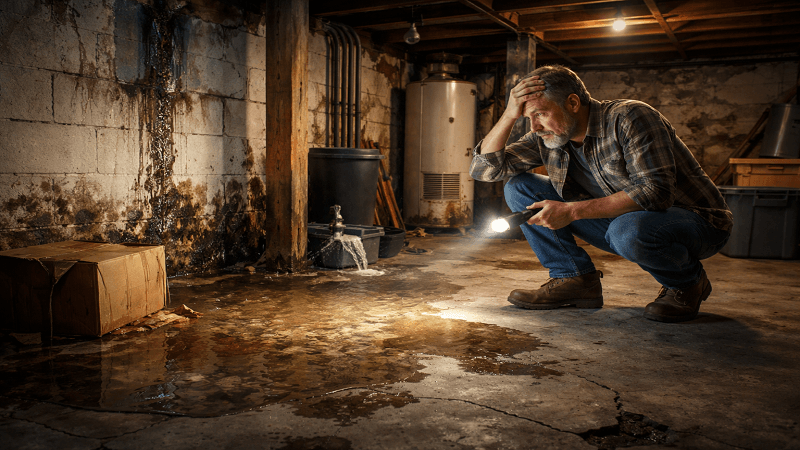
Most basement problems don’t start with something obvious.
Nothing dramatic happens. No water rushing in, no sudden cracks. It’s usually something small that feels easy to ignore. You notice it once, then forget about it. Then it shows up again, and you still don’t think much of it.
That’s how it slips past people. By the time it actually looks like a problem, it’s been there for a while. Not days. Usually much longer.
It Usually Starts With Something Easy to Dismiss
For a lot of people, it doesn’t begin with water on the floor.
It’s more like a feeling. The basement smells a bit different. Not strong, just… off. You might notice it when you walk in, then stop paying attention after a minute.
Or the air feels heavier. Slightly damp, but not enough to make you think something’s wrong.
Nothing forces you to deal with it, so you don’t.
But things like that don’t just appear for no reason. Basements don’t randomly change how they feel. If something is different, something caused it.
Most of the time, it comes down to moisture starting to build up where it shouldn’t. Not enough to see, but enough to change the space.
People usually wait at this point. It seems harmless. And most of the time, nothing gets worse right away, which only reinforces the idea that it’s not a big deal.
The Signs People Notice but Don’t Connect
What makes this tricky is that nothing shows up all at once.
You get one small thing, then another later, and they don’t feel related. So you don’t connect them.
One day, there’s a smell. Another time, you notice a small damp spot. Then maybe the paint doesn’t look quite right in one corner. Each of these feels like its own small, separate issue.
But if you look at them together, they’re usually pointing to the same thing. It often looks like this:
- A smell that shows up and then disappears
- Slightly damp areas near the bottom of the walls
- Paint that doesn’t sit flat anymore
- A light residue on concrete that wasn’t there before
- Air that just feels different compared to upstairs
None of that sounds serious. And that’s exactly the problem.
Because once moisture gets into a basement, it doesn’t just go away on its own.
What’s Actually Happening Behind the Walls
By the time you notice those small things, the situation is already past the very beginning.
Water doesn’t need a visible opening to get in. It moves through the ground and presses against the foundation. If it has nowhere else to go, it stays there.
Concrete isn’t completely sealed. It lets moisture pass through slowly. So even if you never see a leak, that doesn’t mean nothing is happening.
Inside, the space starts to change. The air holds more moisture. Surfaces pick it up. Things don’t dry as quickly as they used to.
Nothing breaks. There’s no clear moment where you can say, “This is where it started.” It just keeps going. That’s why people miss it.
When Small Signs Turn Into Real Problems
At some point, it stops being subtle. Not all at once. Just enough that you start noticing it more often.
The smell sticks around longer. Damp spots don’t fully dry. Something feels off more consistently instead of occasionally.
Then actual changes start showing up. You might notice:
- Thin cracks along the walls
- Marks where moisture has been sitting
- Mold in corners or behind stored items
- Floors that don’t feel completely even
- Moisture forming on pipes or nearby surfaces
Now it’s harder to ignore. But this isn’t the beginning anymore. This is what happens after things have been building up for a while.
Why Waiting Feels Fine at First
Most people don’t ignore this because they don’t care. They ignore it because nothing is forcing them to act. There’s no flooding. No major damage. Nothing urgent.
And basements make it easy to postpone things. You’re not in there all the time, so it’s easier to tell yourself it can wait.
The problem is that moisture doesn’t stay still.
It comes back, spreads, dries, then comes back again. Rain adds to it. Dry weather shifts the ground. It keeps repeating.
And over time, that repetition starts to affect more than just the air in the basement.
The Moment It Stops Being “Nothing”
There’s no clear line where it suddenly becomes serious.
It’s more about noticing that the same things keep happening.
Same spots are getting damp. Same smell coming back. Same feeling that something isn’t quite right.
That’s usually the point where it makes sense to stop guessing.
A lot of homeowners at this stage end up calling a local basement waterproofing company just to understand what’s actually going on. Not because everything is falling apart, but because it’s clearly not random anymore.
Getting a real answer early saves a lot of time later.
What Changes If You Catch It Early
When you deal with it early, it’s usually not complicated.
Sometimes it’s just about how water moves around the house. Sometimes it’s airflow. Sometimes it’s sealing specific areas where moisture gets in. Those are manageable things.
But if it keeps going, the solution changes. Now it’s not just about moisture. It becomes about pressure on the foundation, shifting soil, and things that are harder to fix.
And all of that starts from something that didn’t look important.
The Pattern Most People Miss
This kind of problem doesn’t explode. It repeats. That’s the part that gets overlooked.
It’s not one bad storm or one isolated leak. It’s the same conditions happening over and over again.
Water outside, moisture inside, slow changes in between.
Nothing about it feels urgent, which is exactly why it turns into something bigger.
The Bottom Line
Basement issues don’t start with damage. They start with small changes that are easy to brush off.
A smell that wasn’t there before. A damp spot that keeps coming back. Air that feels different for no clear reason.
On their own, they don’t mean much. Together, they usually mean something has already started. And the earlier you take that seriously, the easier it is to deal with it.