
Most of us give more thought to our mattress than our pillow. We compare bed sizes, discuss mattress firmness, and spend time choosing sheets. The pillow often gets a quick squeeze in a store before coming home with us.
Yet it is the part of the bed that supports your head and neck every night. If you regularly fold yours in half, stack two together, or push the filling back into place, it may be worth considering a different material.
A buckwheat pillow might sound unusual, especially if you have only slept on down, polyester, or foam. But its appeal is straightforward: a firm filling that you can shape, with a height you can adjust.
Here is how buckwheat pillows work, what makes them different, and how to decide whether one belongs on your bed.
What Is Inside a Buckwheat Pillow?
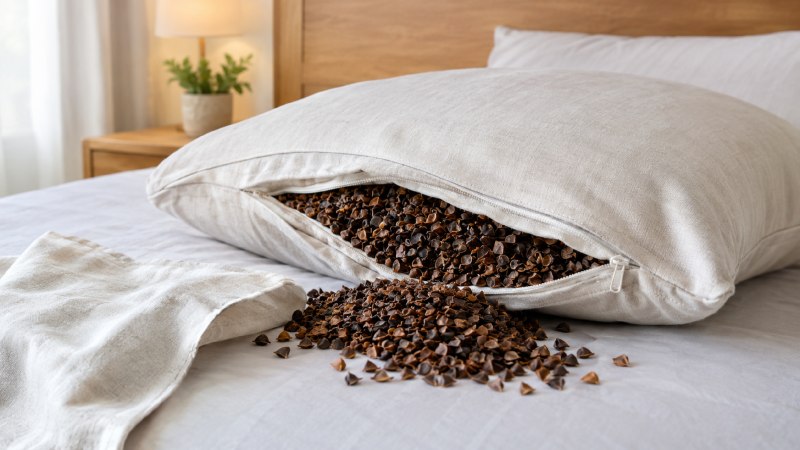
Buckwheat pillows contain the outer shells of buckwheat seeds, known as hulls. These are separated from the edible seed during processing, then prepared for use as filling. The pillow does not contain the buckwheat groats you might cook for breakfast.
The hulls are small, lightweight, and irregularly shaped. When thousands are gathered inside a fabric case, they form a filling that moves freely when rearranged but becomes more stable beneath your head.
Buckwheat pillows are associated with Japanese bedding traditions and are often called sobakawa pillows. Their construction can be simple: a fabric shell, a zipper, and hull filling. Other versions add separate washable covers or blend the hulls with another material.
The defining feature is the way the filling behaves. You can move it into a shape that suits you, then let it settle around your head and neck.
How Does a Buckwheat Pillow Feel?
Expect something noticeably firmer than a fluffy hotel pillow.
Buckwheat hulls do not have the spring of latex or the slow sinking sensation of memory foam. The individual pieces remain firm, while the filling as a whole moves around them.
A useful comparison is a small, densely filled beanbag. Press your hand into the surface and the hulls shift aside, creating an indentation. Move the filling toward one edge and you can build a higher area there.
That is why “firm” does not necessarily mean “flat.” You can shape the surface even though the hulls themselves do not become soft.
There is also sound. The hulls rustle as they move, particularly when you turn your head or reshape the pillow. Some people find this easy to ignore; others find it distracting. Firmness, texture, and sound are all part of the experience, so they deserve as much attention as the potential benefits.
Why Do People Choose Buckwheat Pillows?
The attraction usually comes down to control: control over height, shape, and where the filling sits.
Adjustable Height
With a zippered pillow, you can remove hulls to lower the height or add them back when you want more.
This is useful because pillow height is personal. Two people can sleep in the same position and still prefer different amounts of filling.
It also helps distinguish height from firmness. Removing hulls gives the filling more room to move and lowers the pillow, but the remaining hulls still feel firm. An adjustable buckwheat pillow will not turn into a soft down pillow simply because you empty some filling out.
Shapeable Support
You can create a shallow hollow for your head, leave more filling beneath your neck, or redistribute the hulls across the case.
For someone who already bunches up a conventional pillow, this can feel like a more deliberate version of a familiar habit. You are arranging the support instead of accepting a fixed contour.
Airflow Through the Filling
The spaces between hulls allow air to move through the pillow. That open structure is one reason buckwheat appeals to people who dislike dense bedding.
The complete pillow still matters. A thick pillow protector, outer cover, room temperature, and bedding can all affect how warm it feels. Breathable filling is a useful feature, rather than a guarantee that your pillow will stay cool all night.
Does Your Sleeping Position Matter?
Very much. The same pillow setup can feel suitable in one position and awkward in another.
Side Sleepers
When you lie on your side, there is space between your head and the mattress that the pillow needs to accommodate. Shoulder width and how deeply your shoulder sinks into the mattress affect that space.
A buckwheat pillow lets you change the height and arrange the filling beneath your neck. However, side sleeping also puts pressure on the cheek and ear. Someone who finds a traditional all-hull pillow too firm may prefer a softer filling or hybrid design.
Back Sleepers
Back sleepers often need less height than side sleepers. Too much filling can leave the head feeling pushed forward.
Removing some hulls and making a shallow indentation can help create a lower resting surface. The aim is a position that feels natural, without having to tuck your chin or strain backward.
Stomach Sleepers
Stomach sleepers commonly prefer a very low pillow. Buckwheat’s dense, firm character may be less appealing in this position, even when filling is removed.
Your usual sleeping position is therefore a better starting point than choosing a pillow because someone else loves theirs.
What Are the Drawbacks?
Buckwheat has distinctive qualities, and some of them will be disadvantages depending on your preferences.
It is heavy. A fully filled buckwheat pillow weighs considerably more than many polyester or down pillows. That can make it feel substantial on the bed, but less convenient to lift or carry.
It makes noise. Rustling is part of using loose hulls. Cover construction can affect how noticeable it is, but an all-hull pillow will not behave like a silent block of foam.
It needs adjustment. You may need to change the fill level and learn how you like to arrange it.
It cannot be washed as a complete filled pillow. The hulls need to stay dry, which means cleaning requires a different routine.
Think about your existing habits. If you hug your pillow, fold it under an arm, or prefer a deeply soft surface, buckwheat may feel unfamiliar in ways you do not enjoy. If you want something firm that you can arrange by hand, those same differences may be appealing.
How Do You Adjust One Properly?
Start with your own bed. The mattress influences how much height you need, so testing a pillow while sitting upright tells you relatively little.
Lie in your normal sleeping position and notice whether the pillow feels too high, too low, or uneven. Then make a small change.
To remove filling, place the pillow on a clean surface with the zipper facing upward. Open it carefully and use a scoop or cup to transfer hulls into a clean, dry container.
Close the pillow before testing it again. Redistribute the remaining hulls and give yourself a moment to settle.
Keep the removed filling so you can reverse the change. It is easy to take out too much at once and assume the pillow no longer provides enough support.
Treat the first adjustment as a starting point. You may prefer another small change after using it on your usual mattress for a night or two.
Traditional Buckwheat or a Hybrid?
A traditional buckwheat pillow uses hulls as its main filling. It gives you the most direct experience of their firm, movable structure.
A hybrid combines buckwheat with another material. Depending on the design, that might be latex, wool, or foam. The blend changes the way the surface feels and how the filling responds beneath your head.
The word “hybrid” alone tells you little about the finished pillow. Read what is inside, how the materials are arranged, and whether the filling can be adjusted.
For a practical overview of the category, PineTales’ buckwheat pillow guides cover different designs and everyday use.
A Luxury Pick: The Buckwheat-and-Latex Hybrid
For someone who wants a more luxurious variation, the PineTales Hybrid Buckwheat Pillow combines buckwheat hulls with latex pieces and a removable Tencel™ Lyocell cover.
The latex adds give to the filling, creating a medium-firm alternative to a traditional all-hull pillow. The height remains adjustable by adding or removing filling.
It illustrates how a hybrid can suit someone who likes buckwheat’s shapeable support but wants a softer surface against the face. The choice still comes down to preferred feel rather than assuming a more elaborate design suits everyone.
What Should You Check Before Buying?
Look beyond the filling name. The case, opening, and cover all affect everyday use.
Check for a usable zipper. If adjusting height is a priority, make sure you can access the filling.
Read the dimensions. Buckwheat pillows come in compact sizes as well as familiar bed-pillow dimensions. Measure what you currently use and consider whether you want the same footprint.
Look at the construction. The fabric and seams need to contain loose hulls and carry their weight whenever the pillow is lifted.
Check the cover arrangement. A separate washable outer cover can simplify routine cleaning because the filling stays contained inside.
Understand the materials. A product described as a buckwheat pillow may contain an all-hull filling or a blend. Those options can feel quite different.
Read the purchase terms. Bedding policies vary, so check them before ordering.
A useful shopping question is: “What would make this easier for me to use every day?” That may lead you toward straightforward adjustment, washable covers, manageable weight, or a particular surface feel.
How Do You Clean a Buckwheat Pillow?
The main rule is to keep the hulls dry.
Do not put a filled buckwheat pillow into the washing machine or assume it can go through the dryer. Cleaning instructions generally apply to the fabric components after the filling has been removed.
For regular care, wash the pillowcase or removable outer cover according to its label. If the inner case needs washing, first empty the hulls into a clean, dry container.
Check the seams and corners for remaining pieces before washing the empty case. Let the fabric dry completely before returning the filling.
A hybrid needs its own care instructions, too. Adding latex or another material does not make the blended filling washable.
Consider how this routine fits your household. If your preferred bedding can all be thrown into one wash, buckwheat requires more planning. A removable outer cover can make that difference easier to manage.
A Few Common Misunderstandings
“Natural Means Suitable for Everyone”
Natural materials still have characteristics that some people dislike. Texture, smell, noise, and individual sensitivities all matter. Judge the complete product rather than treating “natural” as a promise about how it will feel.
“More Filling Means Better Support”
A pillow can contain more filling than you need. If extra height pushes your head into an awkward position, removing some may improve the fit.
“A Bigger Pillow Must Be Better”
Extra width can be useful if you move around, but it also means more material and potentially more weight. Choose dimensions for how you sleep rather than how impressive the pillow looks on a made bed.
“You Should Love It Immediately”
Buckwheat behaves differently from familiar fillings. Experimenting with the height and shape is reasonable. Equally, you do not have to force yourself to enjoy a material simply because other people recommend it.
Is a Buckwheat Pillow Right for You?
Start by identifying the problem you want your next pillow to solve.
Do you keep folding yours to gain height? Do you want to arrange filling beneath your neck? Do you prefer a firm surface but struggle with fixed pillow shapes? Those are useful reasons to consider buckwheat.
If your favorite pillow is soft, light, and easy to scrunch into your arms, your priorities may point elsewhere.
Before buying, pay attention to how you use your current pillow over several nights. Notice your sleeping position, the height you prefer, and what you keep changing.
That gives you a more useful shopping checklist than a general promise of better sleep. Buckwheat’s appeal lies in its particular combination of firmness, shape, and adjustability. When those qualities match what you want, it can be a worthwhile change to an everyday part of your bed.