
A healthy garden depends on consistent and appropriate watering, but providing enough moisture does not mean using as much water as possible. Overwatering can be just as harmful as underwatering. It can weaken plant roots, contribute to fungal problems, wash nutrients away from the soil, and increase household water consumption. For homeowners who want a healthier landscape and a more responsible approach to outdoor watering, understanding exactly how much water an irrigation system uses is an important first step.
Garden irrigation can be difficult to manage when watering is based entirely on guesswork. A sprinkler may run for 30 minutes every morning, but that does not tell you how much water is actually being delivered. Measuring water consumption and observing the performance of irrigation equipment can provide a much clearer picture. With a few practical adjustments, gardeners can reduce waste while still giving lawns, flowers, shrubs, and vegetables the moisture they need.
Why Measure Garden Water Consumption?
Every garden has different watering requirements. Soil type, plant selection, temperature, rainfall, sunlight, and garden size can all influence how much water is necessary. A lawn growing in sandy soil, for example, may require different watering practices from one growing in heavier soil.
Measuring water usage allows homeowners to move away from assumptions and make decisions based on actual information. If an irrigation system consumes a large volume of water during every cycle, it may be possible to reduce the duration or improve the distribution of water.
Monitoring usage can also reveal unusual changes. A sudden increase in consumption could indicate a leaking pipe, broken sprinkler, damaged hose, or faulty irrigation component.
Understanding Water Flow
Water flow is an important part of irrigation management. It describes how quickly water moves through a pipe, hose, or irrigation line. Knowing the flow rate can help gardeners estimate how much water their outdoor system delivers during a particular watering period.
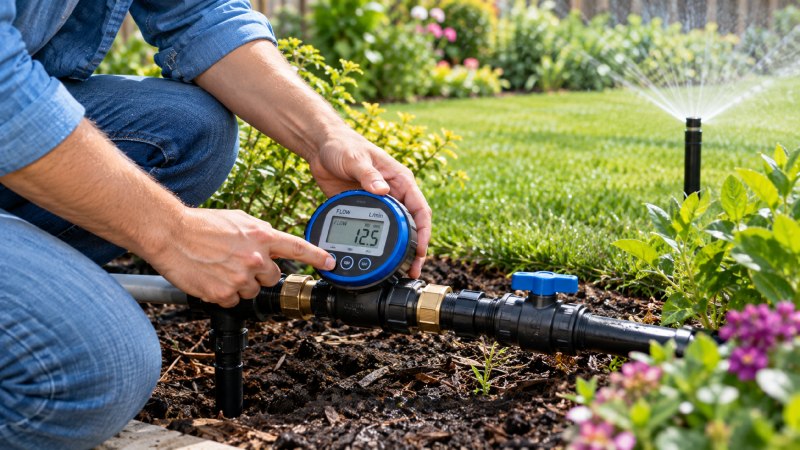
A water flow meter can be used to measure the volume of water passing through an irrigation line. Depending on the equipment, measurements may be displayed in liters, gallons, or another unit. This gives homeowners a practical way to monitor irrigation consumption instead of simply estimating it from watering time.
A flow meter can be particularly useful when comparing different zones in an automated irrigation system. If one zone uses significantly more water than expected, further inspection may reveal a leak, oversized sprinkler, or another problem affecting efficiency.
For example, suppose an irrigation line delivers 10 liters of water per minute. Running that line for 20 minutes would use approximately 200 liters. Extending the watering time to 40 minutes would double the estimated consumption. Having this information makes it easier to evaluate whether a watering schedule is appropriate.
Inspect Irrigation Equipment Regularly
An efficient watering system depends on equipment that is functioning correctly. Sprinkler heads can become blocked by soil, grass, or debris. Hoses can develop cracks, while underground irrigation pipes may develop leaks that are difficult to notice immediately.
Walk through the garden while the irrigation system is operating. Look for water spraying in unusual directions, puddles forming around sprinkler heads, or areas receiving little water. A sprinkler that is partially blocked may create dry patches while another section of the lawn receives excessive moisture.
Regular maintenance also helps extend the life of irrigation equipment. Cleaning sprinkler heads, checking connections, and replacing damaged components can prevent water from being wasted unnecessarily.
Check for Hidden Leaks
Some irrigation leaks are easy to identify, while others may remain hidden underground. One useful approach is to monitor water consumption when all outdoor fixtures are supposed to be turned off. Unexpected water movement may indicate a leak somewhere in the system.
For underground irrigation networks, a professional inspection may be necessary when the source cannot be found. Signs such as unusually green patches, constantly damp soil, sinking ground, or unexplained increases in water consumption can justify further investigation.
Fixing leaks promptly is one of the simplest ways to improve outdoor water efficiency.
Avoid Watering on a Fixed Schedule All Year
A watering schedule that works during a hot summer may not be appropriate during cooler or rainy periods. Gardens generally require different amounts of water depending on weather conditions and plant growth.
Instead of automatically watering every day, check soil moisture and recent rainfall before starting the irrigation system. If the soil is already adequately moist, another watering cycle may not be necessary.
Smart irrigation controllers can also help adjust watering according to changing environmental conditions. Some systems use weather information, rainfall sensors, or soil moisture data to reduce unnecessary irrigation.
Water at the Right Time
Timing can influence how efficiently water reaches plant roots. Early morning is often a suitable time for outdoor watering because temperatures are usually lower than later in the day. This can reduce evaporation and allow water to penetrate the soil before the heat becomes intense.
Watering during the hottest part of the day may result in more water being lost to evaporation. Strong winds can also carry sprinkler water away from the intended area.
The ideal watering time will depend on the local climate and individual garden conditions, but avoiding unnecessary evaporation is an important part of efficient irrigation.
Improve Sprinkler Coverage
A sprinkler system should distribute water relatively evenly across the area it is designed to cover. Poor coverage can result in some parts of a lawn becoming saturated while other sections remain dry.
Place small containers in different areas of the lawn and operate the sprinkler for a specific period. Compare the amount of water collected in each container. Large differences may indicate that the sprinkler layout needs adjustment.
Sometimes simply changing the position of a sprinkler can improve coverage. In other cases, replacing an unsuitable sprinkler head or adjusting its spray pattern may be necessary.
Consider Drip Irrigation
Drip irrigation can be a useful option for flower beds, vegetable gardens, shrubs, and other areas where water needs to be delivered directly to plants.
Instead of spraying water across a large area, drip systems release water slowly near the root zone. This can reduce evaporation and minimize water reaching paths, driveways, or other areas where it is not needed.
Drip irrigation also allows gardeners to separate plants with different watering requirements. Plants that need more moisture can be managed separately from drought-tolerant varieties.
Improve Soil Moisture Retention
Efficient irrigation is not only about controlling the amount of water entering the garden. The soil must also be capable of holding and using that moisture effectively.
Adding suitable organic matter can improve soil structure and help retain moisture around plant roots. Mulching around plants can further reduce evaporation and protect the soil from rapid moisture loss.
However, gardeners should avoid excessive watering simply because the surface of the soil appears dry. Checking moisture below the surface can provide a better indication of whether plants actually need additional water.
Choose Plants Carefully
Plant selection can have a major influence on irrigation requirements. Plants naturally suited to the local climate often require less supplemental watering once established.
Grouping plants according to their water requirements can also simplify irrigation management. Instead of giving the entire garden the same amount of water, separate irrigation zones can be created for lawns, vegetables, flowers, shrubs, and drought-tolerant plants.
This approach helps prevent plants with low water requirements from receiving the same amount of irrigation as plants that need more frequent watering.
Keep Track of Irrigation Performance
Keeping a simple record can make garden water management easier. Write down watering times, estimated consumption, rainfall, weather conditions, and any changes made to the irrigation system.
Over several weeks, these records can reveal useful patterns. You may discover that the garden needs less water after rainfall or that one irrigation zone consistently consumes more water than another.
The objective is not simply to reduce water use at any cost. Plants still need adequate moisture to remain healthy. The goal is to deliver the right amount of water to the right place at the right time.
Conclusion
Efficient garden irrigation begins with understanding how water is being used. Measuring consumption, monitoring water flow, checking equipment, repairing leaks, improving sprinkler coverage, and adjusting watering schedules can all help reduce unnecessary outdoor water use.
Tools such as a water flow meter can make irrigation monitoring more precise by showing how much water passes through an irrigation line. Combined with regular maintenance, thoughtful plant selection, soil management, and appropriate watering schedules, measurement can turn garden irrigation from a guessing game into a manageable system.
A water-efficient garden does not have to sacrifice appearance or plant health. With careful monitoring and practical irrigation management, homeowners can maintain attractive lawns and gardens while making better use of one of the most important resources available.