
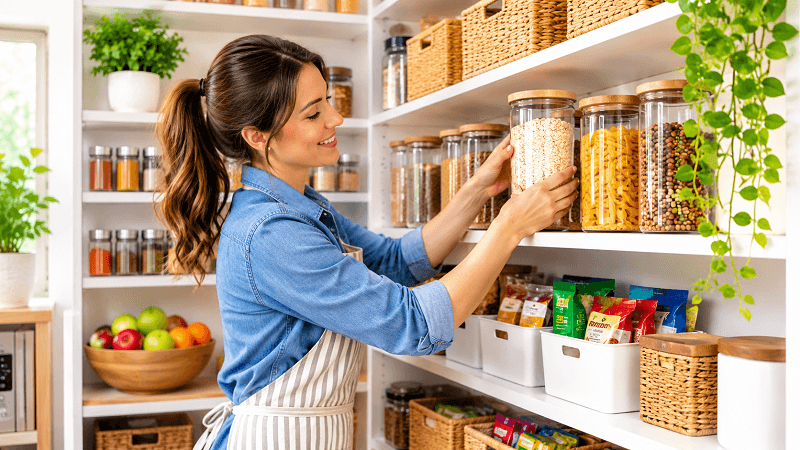
You cleaned the pantry last month. It looked great. For about two weeks. Now cereal boxes are stacked on the floor again. Sound familiar?
Here’s the good news. You didn’t fail. The system did. Most pantry fixes are built for a photo. Real life happens on a Tuesday night. Kids are hungry. Dinner’s late. Somebody’s in a hurry. A system has to survive that.
At Messy Buns Organized Spaces, we organize pantries across Dallas-Fort Worth. We’ve seen the tidy ones and the buried ones. Zero judgment, promise. Here’s what we’ve learned about the pantries that last.
Why does a pantry fall apart after two weeks?
Because it wasn’t built around you. A pretty pantry follows a trend. A working pantry follows your habits. That’s the whole difference.
Think about how your household really eats. Who grabs the snacks? Who cooks? Where do groceries land first? If the answers don’t match the shelves, the shelves lose. Every time.
Then there’s the back-of-the-shelf problem. You can’t see it, so you buy it again. A third jar of cumin. Four boxes of pasta. It adds up fast.
How do you know your pantry needs a reset?
Two or more of these? It’s time.
- You buy things you already own, because you can’t see the back of the shelf
- It looked good for two weeks, then slid
- Nobody else in the house can put groceries away correctly
- Food expires behind other food
- Your kids can’t reach what they’re allowed to have
- You moved into a new build with a big pantry and no plan
None of that is a character flaw. It’s a layout problem. Layout problems have fixes.
Where do you start?
Take everything out. Yes, everything. It feels dramatic. It works.
Now check every date. Toss what’s expired. Group the duplicates. Count them. You’ll be surprised. Most people are.
Here’s our rule. Edit first. Buy containers later. Bins bought ahead rarely fit. You’ll hold one up to the shelf and sigh. So don’t run to the container store first. The sort tells you what you need.
When we organize a pantry, we clear expired food as we work. Food that’s still in date leaves for donation the same day, and you get a receipt.
What should you toss, and what should you keep?
Be honest. Toss what’s expired. Toss what’s stale. Toss the half-used bag you’ll never finish. Keep what you actually cook with.
Ask one question about every item. Did we use this in the last few months? If not, why is it here? Do you really need a fourth kind of flour? Probably not. Unopened extras that are still in date can go to donation. Someone will use them.
How should you zone a pantry?
Zone it by the meals you actually make. Not the meals you wish you made.
Baking supplies live together. So do breakfast items and pasta night. Put the daily stuff at eye level. Put the once-a-month stuff up high or down low. Simple.
Now think about your kids. Give them a shelf at their height. Fill it with snacks you’re happy to see them grab. They get some independence. You get fewer requests at 4 p.m.
Then add a backstock shelf. One shelf. Counted, not guessed. Say it holds two jars of peanut butter. That’s the limit. A third one waits until one runs out. That single habit stops the doubles.
Do you need matching jars?
No. Please don’t. Matching jars look great online. In real life, they’re a lot of work to refill.
We decant on purpose, not by default. Flour, rice, pasta, cereal, and bagged items that flop over all benefit. You can see the level at a glance. Everything else stays in its box. A box that stands up on its own doesn’t need a new home.
Labels matter more than jars. Put one on the lid and one on the front. Then anyone can read it from any angle. That includes your partner. And the babysitter. And you, tired, at 9 p.m.
What does a working pantry look like on a Tuesday night?
It’s 6:15. You’re tired. Somebody’s asking what’s for dinner. You open the pantry. The pasta is where the pasta lives. So’s the sauce. No digging. No guessing. No second jar of cumin.
That’s the test. Not a pretty photo. A calm weeknight. If your pantry passes it, the system works. If it doesn’t, adjust the zones until it does.
How do you keep it from sliding back?
Make it easy for everyone. A system only one person understands falls apart the first busy week. So label the zones. Show where things go. Keep it obvious.
Then build a restock habit. Before you shop, glance at the backstock shelf. Buy what’s low. Skip what’s full. That’s the whole routine. It takes about a minute.
And adjust as you go. Maybe the kids outgrow the snack shelf. Maybe you start baking more. Fine. Move the zones. A system that never changes turns back into a pile. Real homes change. Your pantry can too.
What if your pantry is tiny?
Same rules. Smaller scale. A cabinet pantry still needs zones. It still needs an edit. It still needs a spot for backstock, even if that’s half a shelf.
Go vertical if you can. Use the back of the door. Keep the daily items in front. Everything else goes behind. Tiny doesn’t mean hopeless. It means every inch has to earn its spot.
How long does a pantry project take?
Less time than you’d think. A cabinet pantry usually takes about half a day. A walk-in pantry is most often one full day with two organizers. Want the kitchen cabinets done too? Plan on a second day.
On our pantry projects, we plan 6 to 10 hours. Our rate is $160/hour per team. So labor runs $960 to $1,600. Organizing products are billed separately, at cost. We don’t sell product packages.
If you’d rather hand it off, a professional pantry organizer in Dallas-Fort Worth can do the edit, the zones, and the labels for you. You don’t need to be there the whole time. Most clients join us for the first hour and the final walkthrough.
What’s the easiest first step?
Pick one shelf. Today. Edit it. Group it. Label it. That’s it. One shelf proves the system works. Then do the next.
And if you want a hand, ask. Messy Buns offers a free discovery call. No pressure, no sales script. We’ll talk through your space and share a clear range before anything is booked. An organized home isn’t a luxury. It’s the foundation of a well lived life.