
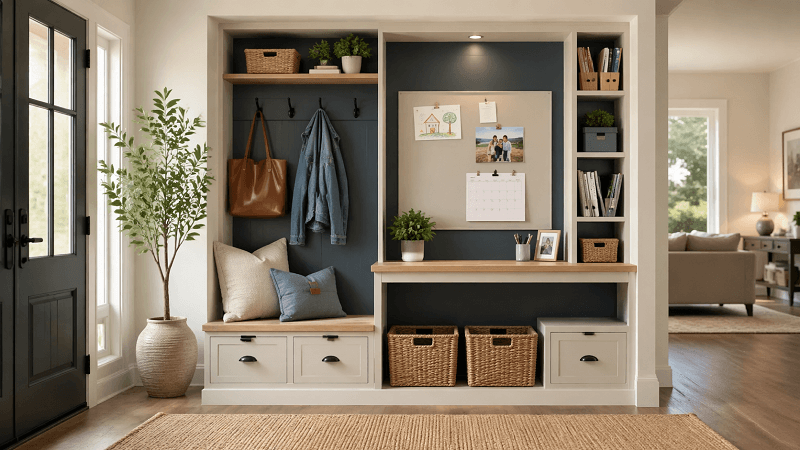
The back door entry is where good intentions go to die. Someone decided there would be a spot for shoes. A spot for bags. Maybe a little hook situation. And for about a week, that worked beautifully. Then real life resumed, and the shoes are back on the floor, the backpacks are on the bench, the bench is also on the floor somehow, and there is a permission slip from October that technically still needs a signature.
The issue is not the family. The issue is that the space was never actually set up to succeed.
1. Hooks at the Door Are Not a Small Thing
When someone walks through a door with full hands, they are looking for the nearest available surface. If there is no hook within reach, the jacket goes on the floor. Not out of laziness. Out of physics. The hook needs to be at the door, at the right height, ready to catch whatever arrives.
One hook per person is the starting point. Two per person is closer to reality, because coats exist in multiple weights and seasons, and nobody rotates them to a closet every evening. Mudroom remodeling that starts with adequate hook placement before anything else begins in the right order.
2. Stop Designing for the Ideal Version of the Family
The mudroom in the catalog has one perfect item per hook and shoes arranged by color in little cubbies. Nobody lives like that. Real mudroom remodeling has to account for the child who will throw the backpack in the general direction of the hook and consider that a success, and the family member who sets things on the bench rather than in the bench because opening the lid requires an extra step they will never take.
Wider hooks catch thrown items. Open shelves get used more than closed bins. A charging station built into the wall means phones actually stop living on the kitchen counter. Design that works with real behavior rather than demanding better behavior is the design that keeps working in March.
3. The Bench Is Doing More Work Than It Looks Like
One behavioral cue is a bench at the entrance. This is where the change from outside to inside takes place, so sit here and remove your shoes. In the absence of it, the transition takes place in the middle of the living room, typically on the rug, in front of someone who is going to enter.
The destination is two feet from where the shoes were taken off, thanks to the shoe storage beneath the bench. That proximity is what makes it actually work. The further the storage is from the action, the less it gets used. This is true of shoe cubbies, of bins, of baskets, of every organizational system that requires a person to walk somewhere before putting something away.
4. A Mirror Changes Whether People Stop
An entryway without a mirror is a space people walk through. An entryway with a mirror is a space people pause in. That pause, ten seconds at most, is when the jacket gets hung properly instead of draped on the nearest thing. It is when the bag gets set in the right spot. It is when the keys make it onto the hook instead of vanishing until Wednesday.
Add good lighting alongside the mirror. Not mood lighting. Functional lighting that makes the space feel like a room rather than a hallway. The combination of light and a mirror is the cheapest part of mudroom remodeling and one of the most effective.
Conclusion
The entryway does not require a complete overhaul to function properly. It requires hooks in the right place, storage that works with actual behavior, a bench that creates the right transition moment, and enough light and mirrors to make people pause. Four things. None of them complicated. All of them are more effective than hoping the family develops better habits on its own.