
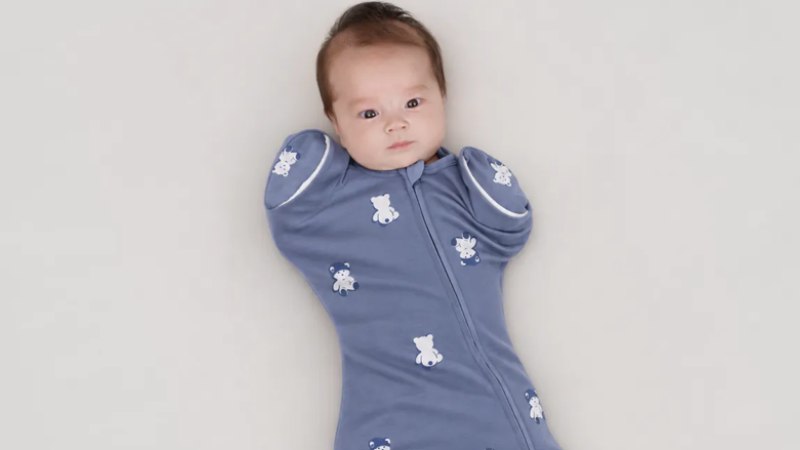
The swaddle works because it recreates the snug feeling that babies are familiar with. In the first weeks of life, being wrapped snugly helps many newborns feel settled in a way that an open sleep space does not.
It also suppresses the Moro reflex, which is the startle response that can jolt a sleeping baby awake when their arms move unexpectedly. For parents, a good swaddle often means more sleep for everyone.
But the swaddle is not meant to last forever. At some point, it stops being helpful and starts becoming a safety concern. Knowing when to make the transition and how to do it without undoing everyone’s sleep is one of those things new parents rarely get a clear answer on.
The timing: watch for rolling, not for a fixed age
The most important signal is not age but movement. As soon as a baby begins showing signs that rolling is coming, practicing tummy-to-side movements, pushing up during tummy time, or successfully rolling in either direction, the swaddle needs to go.
A baby who rolls while swaddled cannot use their arms to push their face away from the mattress, which creates a serious safety risk.
This typically happens somewhere between eight and twelve weeks, though some babies roll earlier. Some parents wait for the first full roll, but the safer approach is to transition when the signs appear, before rolling actually happens during sleep.
Age alone is not a reliable guide. Some babies show rolling signs at six weeks; others are content on their backs for several more months.
Transition from the swaddle to sleep sack
A sleep sack is the most practical next step because it replaces the swaddle’s warmth and the sense of being contained without restricting arm movement. It also acts as a consistent sleep cue over time, as many babies come to associate the sleep sack with the start of their nighttime routine.
Kaiya Baby makes a range of sleep sacks across four TOG ratings: 0.5, 1.0, 2.5, and 3.5, which correspond to different room temperature ranges.
The 0.5 TOG is designed for warm rooms around 75–80°F, while the 3.5 TOG handles cold winter rooms around 57–61°F. Choosing the right TOG means you are dressing the baby for the room, not just for how it feels at bedtime when it is typically warmer.
Bonus tips for the swaddle transition
Some babies move from swaddle to sleep sack without any disruption. Others take a few nights to adjust to having their arms free.
A middle step that many parents find useful is a 2-in-1 swaddle that allows one arm out at a time, letting the baby get used to the new sensation gradually before both arms are free.
Kaiya Baby’s 2-in-1 swaddle is designed with this transition in mind. The adjustable sleeves can be positioned arms-in for a younger baby, or opened for arms-out sleep as the baby approaches the rolling stage.
Once both arms are consistently out and the baby is settling well, moving to a standard sleep sack becomes a much smaller step.
Adjust the base layer for appropriate warmth
One adjustment parents sometimes need to make is how they layer underneath. Without the compression of a swaddle, some babies who were sleeping warmly before may feel the cooler air more.
A base layer that handles temperature regulation, such as a long-sleeve bodysuit or a footed romper in a breathable fabric, can help fill that gap without overheating the baby.
Watching the overnight room temperature and adjusting the base layer accordingly is usually more effective than switching to a heavier sleep sack than the room actually calls for.
The transition is one of the first times parents have to respond to something their baby has outgrown.
It tends to go more smoothly than expected, particularly when the timing is right, and the new sleep setup gives the baby room to move without feeling entirely unmoored.